
Meltdown is a renowned London music festival that has featured curators such as David Bowie, Patti Smith, and Robert Smith. In 2015 was David Byrne turn, the former frontman of Talking Heads, a lyrically innovative songwriter and a world music connosseur. A friend of this publication remembers a sunny August day encountering, by sheer chance, what he heres describes as “the authentic music for the marginalised”
If my memory serves me right, it was a sunny day in August 2015. The Southbank Centre was hosting its prestigious Meltdown festival, that year curated by Talking Heads singer David Byrne, who also loaned part of his book collection to the Royal Festival Hall’s Poetry Library. I borrowed some titles on world music from there. It’s worth noting that Byrne founded the Luaka Bop label, dedicated to promoting world music and responsible for releasing albums by Los Amigos Invisibles, Susana Baca, Tom Zé, and Tim Maia, among many other artists from various countries.
But it was the day I returned those books, late at night, when, passing by the immense balcony on the fifth floor of that memorable cultural center on the banks of the Thames, I stumbled upon a fantastic group of musicians playing funk, reggae, hip hop, and R&B. What made them different wasn’t just that the singer was a giant or the drummer was blind, but something harder to name: their attitude, their energy, an intensity that defied any label.
I approached a man who was providing them with technical assistance and asked him where they were from. He replied that they belonged to an arts center in Shepherd’s Bush called The Gate, which supports neurodivergent people. I asked him if their music was played on any radio stations. He said no. That’s where it all began.
A history of marginality
The history of humanity is, in many ways, the history of a struggle against what we call “rational,” even though they try to convince us otherwise. Just look at the wars, the billionaires siphoning off public resources, the pollution, the excessive consumerism, our political leaders, the abuses and crimes that reality throws in our faces every day to realize that it is not reason that governs, but the opposite.
The arbitrary division between reason and madness has only served to confuse us further. In the early Middle Ages, mental disturbances were attributed to astrological influences or divine punishment. Some people were thought to be possessed by demonic spirits; the Church attempted to exorcise them, and if it failed, they could end up at the stake.

Later, one “solution” was to put them on the so-called Ship of Fools and abandon them to drift until they reached, by chance, some distant port. Others were confined in former leper colonies, spaces originally created to isolate those suffering from that terrible contagious disease. Over time, people with melancholy, delusions, or manias, and even those with distracted or wandering minds, were locked up in general hospitals.
In England, during the Industrial Revolution, the concept was “modernised” and adapted to the logic of the production line: those who didn’t meet the standard were discarded as defective products. The difference is that people are infinitely more complex than objects. We can fail at one task and excel at another; we can have flaws and, at the same time, be emotionally valuable to many.
At the end of the 19th century, the Lunacy Act was enacted, which legally penalized those considered insane, restricting their freedom and confining them in asylums created for that purpose.
The change
It wasn’t until the second half of the 20th century that the legislative approach began to shift toward a scientific perspective on mental health. Its causes were demystified, and the language changed: people began to speak of learning disabilities, dyslexia, autism spectrum disorder, depression, schizophrenia, psychosis, bipolar disorder, and other conditions. Gradually, many people were released from closed institutions and reintegrated into the community.
Another fundamental shift was the social model of disability, promoted by activists in the 1970s and consolidated in the 1980s. In short, it argues that society, by failing to adapt to the diversity of human needs, is what segregates. From this perspective, if a building lacks access for wheelchair users, the problem is not the person, but the building itself, which does not comply with accessibility regulations.
Raw art
In 1922, the Swiss psychiatrist Hans Prinzhorn published The Art of the Mentally Ill, a rigorous study of works produced by patients at the Heidelberg psychiatric hospital. His work inspired surrealist artists such as Max Ernst and Paul Klee, and later Jean Dubuffet, who coined the term art brut to refer to creations made by “natural” artists, without academic training or institutional influences. It also began to be called naïve or outsider art.
In the United Kingdom, people with disabilities represent around 25% of the population. Of these, more than one million use wheelchairs and between 10 and 13.5 million are considered neurodivergent. In the realm of art, Vincent van Gogh set a precedent at the end of the 19th century. In the following century, Wassily Kandinsky and Franz Marc founded the Blue Rider (Der Blaue Reiter) group in 1911, whose almanac proclaimed that their artistic quest went beyond the rational.
The music of the marginalized
In the musical field, the label “outsider music” was adopted by the American journalist Irwin Chusid. It applies not only to musicians who have experienced mental health problems, such as Syd Barrett (Pink Floyd) or Brian Wilson (Beach Boys), but also to eccentric or bizarre artists, such as Captain Beefheart or Frank Zappa.
The category ended up encompassing countless creators outside the mainstream, Wild Man Fischer, Wesley Willis, Lucia Pamela, the Shaggs, or Reynols, until it practically became a genre in itself.
Their aesthetic is often associated with Dadaist or punk attitudes, the DIY spirit, and lo-fi production. However, “do it yourself” has never been absolute: since the invention of instruments and recording systems, music has required collaboration. And as for lo-fi, these artists don’t need the most sophisticated instruments on the market: they can create makeshift instruments from recycled objects, because what’s essential isn’t technology, but expressive urgency.
Gate Kicks
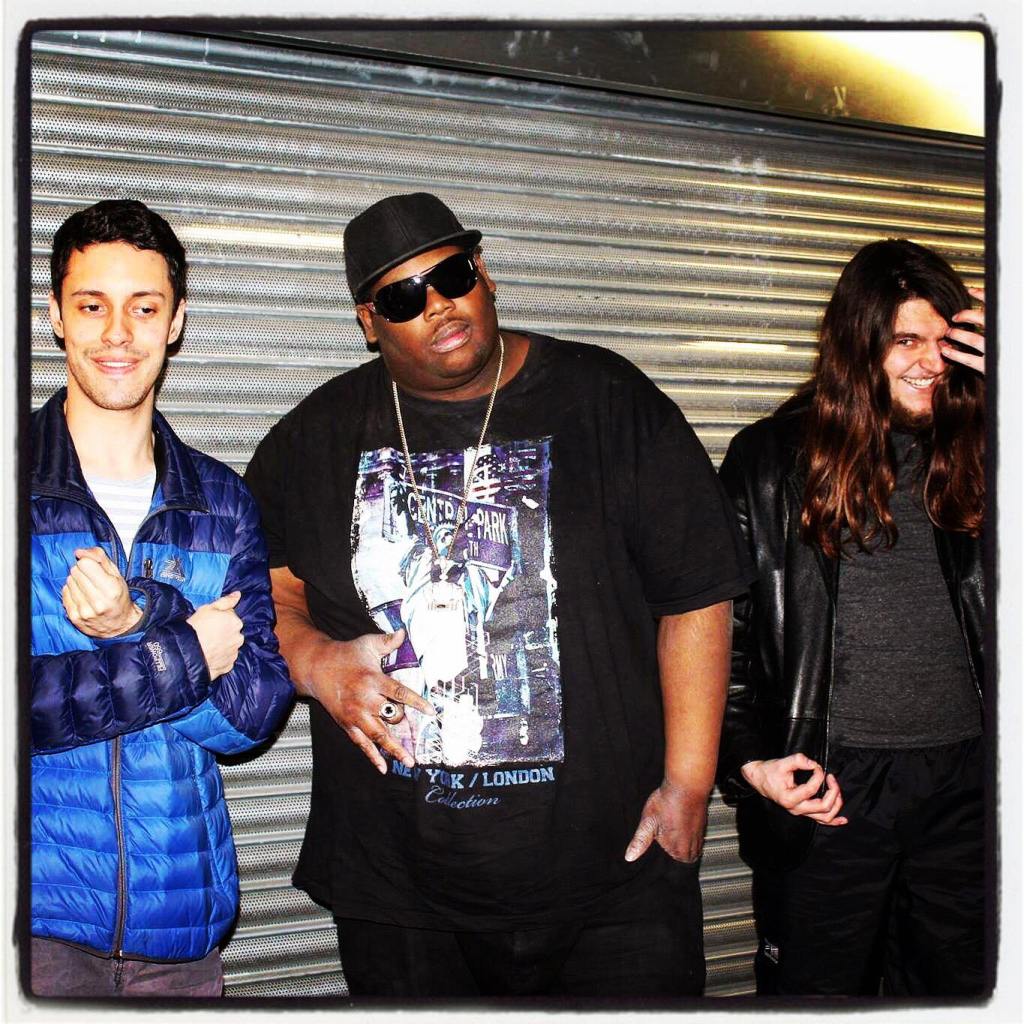
Let’s return to the 21st century, to the fifth-floor terrace of the Royal Festival Hall. There was the band: 2 Decks on vocals; Leon Dubz on bass; Roberto on drums; and Matt on guitar, the latter as a member of the support crew. The concert fulfilled its purpose: to showcase their music and get people dancing.
The following week I spoke with Ed Baxter, editor-in-chief of Resonance FM—the UK’s first art radio station—about the possibility of creating a space to broadcast this music. He wisely approved a weekly thirty-minute program.
I then called Arlo Yates, the technical assistant I had spoken to that evening, who turned out to be the manager of the Gate Art Centre, to offer him the space. He happily accepted. The program was named Gate Kicks by the artists themselves and airs every Wednesday at 1:30 PM on Resonance FM 104.4
After stumbling upon these musicians by accident, I discovered a wonderful world: another segment of the population marginalized for millennia. But what is truly important is that, in an era marked by fake news, neo-fascism, artificial intelligence, influencers, digital platforms, climate change, immigration, and debates about inclusion—all phenomena that question the meaning and value of human beings in present and future society—the music of these marginalized people gives us back something essential.
It reconnects us with people who may never have read a book or researched a topic in depth; without university degrees; unfamiliar with the strategic chess game many use to pursue their goals. And yet, precisely because they are not shaped by the same structures that have led us to the current state of the world, they can be more authentic, more direct, more human.
Perhaps more human than all of us, who at some point, without knowing them, have discriminated against them.
Javier Chandia, despite having a master’s degree, considers himself an amateur journalist, promoter of obscure music, and producer of Gate Kicks https://www.mixcloud.com/Resonance/playlists/gate-kicks/ for The Gate: https://thegateartscentre.blogspot.com/?m=1. In the 1990s he was one of the owners of the anti-record store Zëbëhn Discos (Chile) and, between 2011 and 2017, he produced Latin Waves https://www.mixcloud.com/latinwavesresonancefm/ for Resonance FM: https://www.resonancefm.com/. For more information, visit their Magik Circles blog: https://magikcircles.co.uk
 Magik Circles